Our Tesla has taught its headlights some manners.
If you’ve ever driven a dark country road with your high beams on, you know the routine. A car appears, you flick the high beams off, it passes, you flick them back on. Miss it, and someone gets dazzled. Tesla’s Adaptive Headlights take much of that routine away, and once you understand how they work, you’ll never think about high beams the same way.
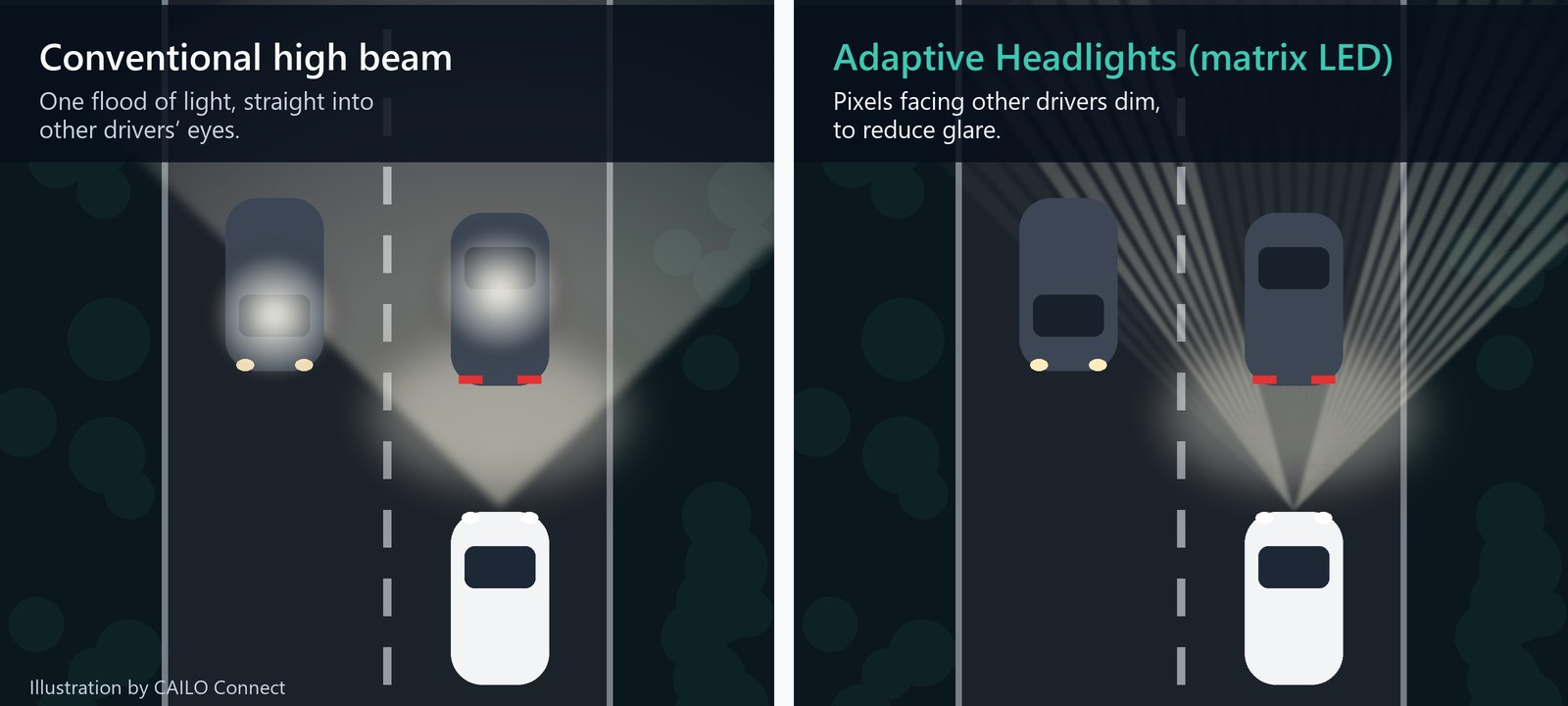
Ordinary high beams are a flood
A conventional high beam is one big wash of light. It lights everything in front of you, including the eyes of the driver coming the other way and the mirrors of the car ahead. So it’s all or nothing: full light for you, or no glare for them.
Matrix LED headlights work more like a screen
Tesla’s matrix LED headlights split the high beam into lots of small segments, like pixels, and each one can be controlled by itself.
The car’s cameras watch the road ahead. When they spot an oncoming car, or a car in front, individual pixels of the high beam dim to reduce glare, while the rest of the beam keeps lighting the road. Tesla says the headlights also adjust to curves in the road ahead.
The result: more light for you, and far less glare for the driver coming the other way.
Does your Tesla have them?
It depends on your market, your car’s configuration and options, and its software. Tesla’s manual gives the simplest check: open Controls > Lights.
- If you see a toggle for Adaptive Headlights, your car has them.
- If you see Auto High Beam instead, your car switches between high and low beam.
Our own Model Y has Adaptive Headlights, and it’s one of those features we appreciate more with every night drive.
Why the US got them later
In the United States, safety rules only allowed adaptive driving beams in February 2022. Tesla brought Adaptive Headlights to US and Canadian owners in its 2025 Spring Update, after Europe. Cars that already had the right hardware could get the feature through software.
It’s a good example of how a Tesla can get better after you buy it, as long as the hardware is already there.
What to know before you rely on them
- Where a car has Adaptive Headlights, they’re on by default. You can turn them off in Controls > Lights.
- If you turn them off, engaging Autosteer or FSD (Supervised) turns them back on.
- Tesla calls this a convenience feature with limitations. You’re responsible for making sure your headlights suit the weather and the road.
The bigger idea
Some of the best features are designed for people who will never own your car. The driver coming the other way gets far less glare, and you see more of the road. That’s technology being considerate, not just clever.
Sources: Tesla Model Y Owner’s Manual, Lights, NHTSA and Tesla North.
Every night drive you take is also kept in CAILO Connect: the trip, the distance and how your battery went, recorded automatically from the car. Start 7 days free.
Give your Tesla a logbook that writes itself
CAILO Connect captures every trip automatically. 7-day free trial on the 1-vehicle plan.
Start Free TrialGeneral information only, not tax, financial or legal advice. CAILO is not a registered tax agent, so speak to one before relying on this for a claim or return.