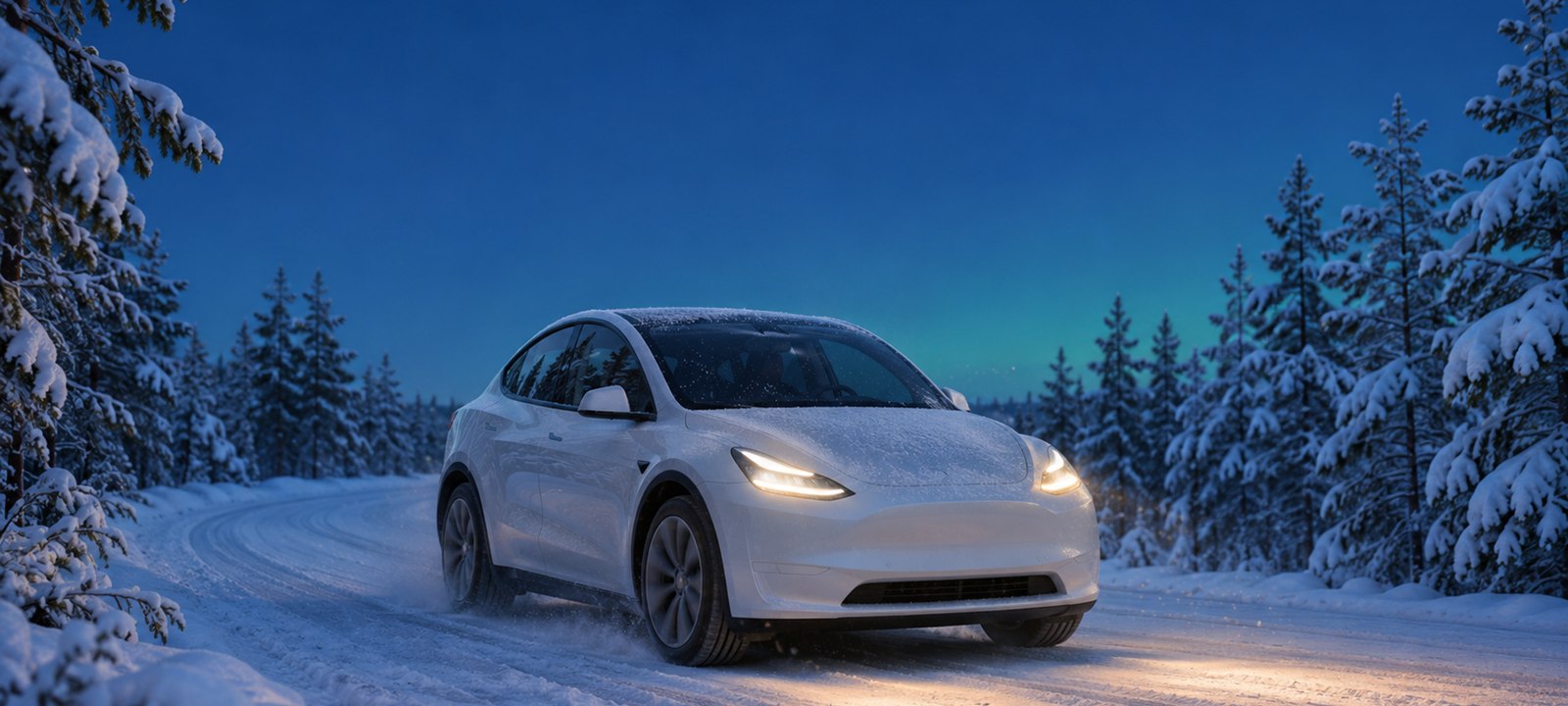
Finland has said yes to Tesla’s supervised driving system. If you drive a Tesla in Australia, it’s fair to ask what that means for you.
The short answer: nothing changes here yet. The more interesting part is what Tesla had to change to get the approval, because it shows what regulators care about. This week we also tried Grok’s voice controls in our own car, and found a new headlight feature that has arrived in Australia.
What Finland approved
On 10 November, Finland’s transport agency, Traficom, recognised a provisional type approval that the Dutch regulator (RDW) had granted earlier. Traficom announced the decision on 11 November. Tesla can now offer the system to drivers in Finland.
In Europe, it has a different name. Traficom’s announcement says the system is called Tesla Assisted Driving. It’s driver assistance: the driver still has to supervise it the whole time.
Traficom also says that snow, slush or dirt on the cameras can limit the system. That’s a reminder that it depends on what the cameras can see.
Finland is the latest of several European countries to approve it. Reports disagree on the exact count, so we won’t give one. An EU-wide decision is expected over the European winter.
Source: Traficom, 11 November 2026.
What Tesla changed to get there
Two changes stand out.
- The name. “Self-driving” is gone from the European name. It’s now Tesla Assisted Driving.
- Speed settings. According to reporting on the Dutch approval, the maximum speed offset has been capped at +10% (it was +50%), and it resets to 0% every time the car starts. Traficom says the system can no longer be set to hold an unnecessarily high speed.
Neither is a new capability. They are rules about how the system is named and how far it can be pushed.
Sources: Traficom and Electrek, 3 November 2026.
What it means for Australia
What we know: nothing in Finland’s decision changes FSD (Supervised) in Australia. There’s no new version, no new feature and no change to the name. Here it’s still FSD (Supervised), and you still supervise it.
What we think: the European changes show what regulators tend to ask for: a name that doesn’t overpromise, limits on speed, and clear information for the driver. That’s useful context. It isn’t a sign of an Australian change.
What we’re watching for: Australian release notes, a statement from an Australian regulator, or any change to how Tesla names the system here. When something real happens, we’ll cover it.
If you use FSD (Supervised), the most useful number is your own: how much of your driving it actually did. CAILO Connect shows that on compatible cars, approximately and month by month, from what the car reports. See how FSD (Supervised) tracking works.
Grok in the car: we tried it
Grok can now do a lot more than talk. Not a Tesla App’s Nehal Malik pulled together everything it can control, based on a Tesla owner, @LifeMiddie, who tested 172 voice commands. Grok handled 119 of them.
We tried a few in our own car in Australia. You don’t press anything. You just say “Hey Grok”, then:
- ”Open the glovebox.” It opened.
- ”Find a Supercharger on my route.” It found one.
- ”I’m cold.” It turned the temperature up.
All three worked really well, and not having to press a button makes it feel natural.
Other things Grok can handle include heated seats and the steering wheel, Dog Mode and Camp Mode, opening the charge port, Sentry Mode, music, calls, location-based reminders (“Remind me to charge when I get home”) and reading out the release notes.
What it can’t do yet: lock or unlock the doors, open the boot or frunk, change the acceleration mode or pause music.
What you need: a car with the AMD Ryzen infotainment computer (Intel cars aren’t supported yet), Premium Connectivity or Wi-Fi, and Grok set to the Assistant personality. Tesla’s Australian owner’s manual notes that availability can depend on your car and market.
Source: Not a Tesla App, “Everything you can control with Grok in your Tesla”, Nehal Malik, 6 November 2026.
Headlights that level themselves
This one arrived quietly. Tesla is rolling out Dynamic Headlight Leveling to selected cars, and it’s in ours.
Your low beams normally point at a fixed angle. When the front of the car tips up, on a steep hill, under hard acceleration or with a heavy load in the boot, they can end up shining into oncoming drivers’ eyes. Dynamic Headlight Leveling uses small motors in the headlights to adjust their aim as the car moves, which cuts glare for everyone else on the road.
It’s different from two features you may already know:
- Adaptive Headlights use the matrix high beams to dim parts of the beam around other cars.
- Adjust Headlights (Controls, Service) is a manual calibration you do once.
Tesla hasn’t announced it, and it’s only on a limited number of cars so far. When Not a Tesla App first reported it, it had been seen in the US and the UAE. Now it’s here: it has turned up in our own car in Australia, and it’s fantastic.
To check whether you have it: go to Controls, Software, Release Notes and look for “Dynamic Headlight Leveling”. If you find it, tell us which model you drive, on our Facebook page.
Source: first reported by Nehal Malik at Not a Tesla App: “Tesla quietly rolls out new Dynamic Headlight Leveling to select cars”, 1 October 2026.
A door warning many owners don’t know about
If your Tesla detects something approaching, such as a cyclist, as a door is about to open, it can warn you in several ways. According to Tesla’s owner’s manuals:
- a red light blinks in the upper speaker grille
- an alert appears on the touchscreen
- the accent lights turn red
- the door doesn’t open on the first press of the button (press again to open it)
It’s an extra warning, not a guarantee. Everyone still needs to look before opening a door. The manual also says not to assume the doors are locked when the car is in Park.
Source: Tesla Model Y Owner’s Manual, Lane Assist.
Cybertruck: production extended, but still ending
Elon Musk says Cybertruck production will continue through the end of the northern summer of 2027, so Tesla can work through more orders. That adds a few months to the earlier plan. The line is still expected to close, to make room for Cybercab.
There’s no confirmed end date, and no promise that every order will be filled. Musk has said some deposits will be refunded. One thing this doesn’t mean: Tesla isn’t stopping making cars. That claim has been doing the rounds, and nothing supports it.
Source: Electrek, 11 November 2026.
On our watchlist
- The EU decision on Tesla Assisted Driving. Expected over the European winter.
- The 2026 Holiday Update. Tesla hasn’t announced it. We’ll cover it when the release notes appear.
- Dynamic Headlight Leveling. Which Australian models have it. Tell us if yours does.
- Software 2026.38.100. A small update with minor changes and nothing major for Australian owners.
Whatever’s in the next update, CAILO Connect keeps the record: trips, charging and receipts, and FSD (Supervised) use on compatible cars.
Give your Tesla a logbook that writes itself
CAILO Connect captures every trip automatically. 7-day free trial on the 1-vehicle plan.
Start Free TrialGeneral information only, not tax, financial or legal advice. CAILO is not a registered tax agent, so speak to one before relying on this for a claim or return.